

The science of antioxidant peptides directed at mitochondria represents one of the most revolutionary and sophisticated advances in modern biomedicine and anti-aging research.
To understand the magnitude of this science, we must analyze why it was created, how it managed to penetrate cells and why it is surpassing the growth of traditional supplements in clinical trials.
Next, I detail the scientific basis of this pharmacological technology:
Mitochondria are the energy centers of our cells, responsible for producing ATP (energy) through a process called oxidative phosphorylation. However, this process has a lethal cost:
During energy production, a small percentage of electrons “escape” from the transport chain and react with oxygen.
This generates Reactive Oxygen Species (ROS), commonly known as free radicals.
At normal levels, ROS are useful cellular signals. But with ageing, toxins, bad diets or illnesses, mitochondria become empathetic and fail and produce an avalanche of ROS. This massive oxidative stress destroys mitochondrial DNA, oxidizes proteins and triggers cell death (apoptosis). This is the biological basis of aging and, in particular, all degenerative diseases.
For decades, medicine has attempted to combat this by prescribing massive doses of conventional antioxidants (Vitamin C, Vitamin E, Coenzyme Q10). Science demonstrated that it failed resoundingly. Why?
Ineffective distribution: Vitamins are dispersed throughout the cytoplasm (the “broth” of the cell) or the blood stream, but only a tiny fraction manages to penetrate into the mitochondria, which is where ROS actually originate.
The mitochondrial barrier: The mitochondria has a double membrane that is extremely selective and impermeable. For a traditional antioxidant to reach therapeutic concentrations inside, doses so brutally high that they would be toxic to the rest of the body would have to be administered.
To solve this problem, scientists (highlighting Hazel Szeto and Peter Schiller) designed a new class of synthetic molecules: Szeto-Schiller peptides (SS peptides).
The science behind its design is pure biochemical engineering:
Alternating structure: These peptides are very small (they only have 4 amino acids, which is why they are called tetrapeptides). They are designed alternating aromatic amino acids (which are water repellent or hydrophobic) and basic amino acids (which have a positive electrical charge).
The “Troy Horse Effect”: This unique structure allows it to be soluble in water to travel through the blood, but also has time to easily cross thick cell membranes without the need to use receptors or energy transporters.
Electromagnetic affinity: The interior of an active mitochondria has a strong negative electrical potential. As these peptides have a cationic (positive) charge, they are magnetically attracted to the interior of the mitochondria. The result is astonishing: they are concentrated in the inner mitochondrial membrane between 1,000 and 5,000 times more than in the cell exterior.
Once the antioxidant peptide (such as SS-31 / Elamipretida) has penetrated and “capped” in the inner membrane of the mitochondria, it acts in two scientifically proven ways:
Action 1: Direct Basure (Scavenging): Some remains of the molecule have the chemical capacity to donate electrons to neutralize toxic free radicals (such as hydrogen peroxide or superoxide anion) in the very instant and millimeter in which they are generated, before they can damage mitochondrial DNA.
Action 2: Structural Maintenance (Cardiolipin Stabilization): As we have seen in recent investigations, the true genius is not cleaning the base, just cleaning the engine. These peptides bind to cardiolipin (the structural fat of mitochondria) to prevent it from oxidizing. By keeping the motor structure intact, the mitochondria stops “losing acceptance” (ROS) and returns to producing energy (ATP) in a clean way.
Given that mitochondrial dysfunction is the common denominator of countless pathologies, the science of these peptides is being applied in high-level clinical trials around the world:
Damage from Ischemia-Reperfusion: When someone suffers a heart attack, the flow of blood stops (ischemia). When doctors manage to release the artery and the blood comes back in by blow (reperfusion), the massive oxygen shock causes the mitochondria to release a lethal amount of free radicals, killing the heart tissue. Peptides directed to mitochondria are injected to shield the cells and prevent this massive death of the heart tissue.
Neurodegenerative Diseases: In pathologies such as Alzheimer's, Parkinson's, ALS (Amyotrophic Lateral Sclerosis) or Huntington's disease, science has demonstrated that neuron mitochondria begin to fail and produce oxidative stress years before symptoms appear. Peptides like SS-31 have demonstrated in animal models the ability to cross the blood-brain barrier, protect neurons and improve motor and cognitive functions.
Nephrology (Riñones): The kidneys have immense energy expenditure. Clinical trials are using these peptides to treat acute kidney injuries and prevent chronic renal fibrosis by saving the mitochondria of the renal tubules.
Transplant Medicine: These molecules are being used in liquid solutions to preserve donor organs before transplantation. By protecting the organ's mitochondria while the body is burning, it drastically increases its viability and reduces subsequent rejection.
In conclusion: The science of antioxidant peptides targeted at mitochondria has abandoned the old idea of “flooding the body with vitamins” and has embraced precision nanomedicine. It is, literally, taking a microscopic repair kit directly to the boiler room of the cell that needs it, right at the exact moment it is failing.
SERMORELIN PEPTIDE.
Recommended for improving your health, your well-being and your recovery.
How it works:
Stimulates the pituitary gland to release natural GH, activating the body's physiological production.
For whom is it indicated:
Peopleas con sueño lighto.
Patients with fatigue and low energy.
Men and women older than 30 years.
People looking for gentle anti-aging.
People who want to improve their skin and collagen.
What a improvement:
Deep dream.
Muscle recovery.
Slight increase in muscle mass.
Firmness of the skin.
Energy and vitality.
Sermorelin → smooth and sueño natural GH.
Safe and effective under the supervision of a specialist doctor.
Approved by the FDA.
Tesamorelin peptide.
Powerful for visceral fat and metabolism.
How it works:
Stimulates GH and IGF-1 with greater intensity, improving body composition and reducing persistent abdominal fat.
For whom is it indicated:
Persons with persistent abdominal fat.
Slow metabolism.
From the age of 30-35.
Those looking for performance and aesthetics.
They may find it difficult to gain muscle mass.
What a improvement:
Reduction of visceral fat.
Increase in lean mass.
Deep dream.
Muscle recovery.
Energy and vitality.
Fast metabolism.
Tesamorelin: Visceral fat and metabolism.
Safe and effective under the supervision of a qualified doctor.
Approved by the FDA.
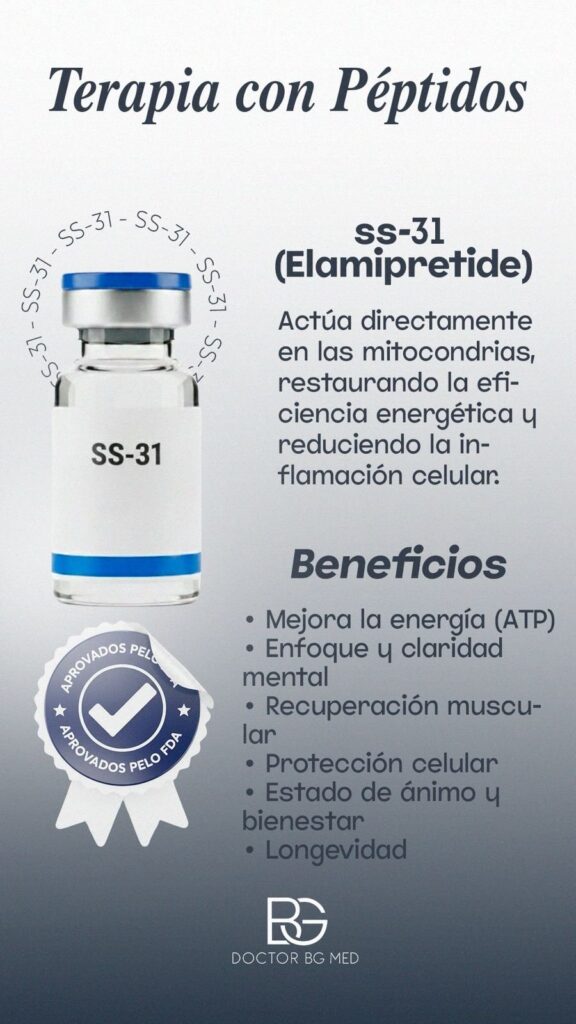
Elamipretide SS-31 peptide.
Mitochondrial peptide: energy, concentration and longevity.
How it works:
It acts directly on the mitochondria, restoring energy efficiency and reducing cellular inflammation.
For whom is it indicated:
Constant fatigue.
Low vitality.
Seniors over 35 years old.
Overworked professionals and sportspeople.
Quienes buscan longevidad.
What a improvement:
ATP energy.
Concentration and mental clarity.
Muscle recovery.
Cellular protection.
Mood and well-being.
Longevity.
SS-31 Mitochondrial energy and deep anti-aging.
Safe and effective if used under the supervision of a qualified doctor.
Approved by the FDA.
Doctor G Medical Excellence: Health, Bienestar and Longevidad
4243 W Hillsboro blvd Coconut Creek, 33073, FL
Phone: +1 (954) 638-1515
| Monday | 09:00 - 17:00 |
| Tuesday | 09:00 - 17:00 |
| Wednesday | 09:00 - 17:00 Open now |
| Thursday | 09:00 - 17:00 |
| Friday | 09:00 - 17:00 |
| Saturday | 09:00 - 17:00 |
| Sunday | Closed |