

To understand the relationship between Elamipretida (SS-31) and oxidative stress, it is necessary to first dismantle one of the most extended beliefs in the world of supplementation.
Most people think that to combat free radicals — scientifically known as Reactive Oxygen Species (ROS) — it is enough to take antioxidants that act as “sponges” absorbing toxicity. Elamipretida has demonstrated that this strategy is inefficient and has introduced a radically different approach: it does not clean toxicity, it prevents it from being manufactured.
Next, I will detail scientifically how this peptide manages to reduce oxidative stress so drastically.
To understand the value of Elamipretida, we must look at the cell's energy assembly chain:
In the inner membrane of the mitochondria, protein motors (Complejos I to IV) pass electrons from one to the other to generate energy.
Mechanical failure: No 100% engine is efficient. In a healthy mitochondria, between 1% and 2%, electrons “escape” from the transport chain before reaching their final destination.
The birth of ROS: These escaped electrons collide with the oxygen molecules we breathe and transform them into superoxide anions and hydrogen peroxide. These are the famous ROS (free radicals).
Under conditions of aging, illness or lack of oxygen (ischemia), the structure of the mitochondria collapses. Electron leakage becomes massive and ROS flood the cell, destroying DNA, oxidizing proteins and causing cell death (apoptosis).
When you take high doses of Vitamin C, Vitamin E or Coenzyme Q10, these molecules travel through your body trying to hunt down and neutralize the ROS that are freely floating around.
The clinical problem is triple:
It costs enormously to penetrate the double barrier of mitochondria.
Come on in the afternoon: try to put out the fire when the ROS are damaging the internal structures.
If the dosage is very high, it can interfere with normal cellular signaling, as the body needs a minimum level of ROS for the cells to communicate.
La Elamipretida does not pursue free radicals. Its mechanism is purely structural and preventive, acting directly on the core zone of oxidative stress:
Union with Cardiolipin: As we have seen in other functions of this peptide, Elamipretida travels inside the mitochondria and attaches itself to cardiolipin, the lipid that holds together the motors of the electron transport chain.
Coupling of supercomplexes: To stabilize the cardiolipin, the energy motors (especially Complejo I and Complejo III, which are the main “escapers” of electrons) close together and are hermetically coupled.
Leakage Prevention: Once the circuit is closed and well connected, the electron transfer will be clean and efficient. Loss of electrons has left the void.
The result: There are no leaked electrons, there are no collisions with oxygen. ROS production has drastically expanded since its origin.
There is a second crucial mechanism by which Elamipretida reduces oxidative stress in critical situations (such as a heart attack):
In situations of high stress, a transport protein called cytochrome becomes “loca”. If it takes cardiolipin and turns it into a peroxidase enzyme, that is, it begins to generate industrial amounts of ROS to destroy the mitochondria and force cellular suicide.
Elamipretida is physically interposed between the cytochrome and cardiolipin. By blocking this toxic union, it turns off the cellular self-destruction switch and stops this massive oxidative storm dry.
Braking oxidative stress from within the mitochondria has cutting-edge medical applications that are currently being investigated in clinical trials:
Ischemia-Reperfusion Injury: When someone suffers a heart attack and doctors unseat the artery, the sudden entry of oxygen generates a lethal explosion of ROS that kills the heart tissue. Elamipretida is being investigated to block this oxidative explosion and save the heart muscle.
Neuroprotection: The brain is extremely sensitive to oxidative stress. By reducing mitochondrial ROS, neurons are protected from the progressive deterioration seen in pathologies such as Parkinson's or Alzheimer's.
Cellular anti-aging: At a biological level, aging is driven by the cumulative damage of ROS in cellular DNA. Stopping the production of ROS in the mitochondrial factory is the most direct way known to science to slow down the cellular biological clock.
Would you like me to detail how current clinical trials are being designed exactly using Elamipretida to treat heart injuries following an acute myocardial infarction?
SERMORELIN PEPTIDE.
Recommended for improving your health, your well-being and your recovery.
How it works:
Stimulates the pituitary gland to release natural GH, activating the body's physiological production.
For whom is it indicated:
Peopleas con sueño lighto.
Patients with fatigue and low energy.
Men and women older than 30 years.
People looking for gentle anti-aging.
People who want to improve their skin and collagen.
What a improvement:
Deep dream.
Muscle recovery.
Slight increase in muscle mass.
Firmness of the skin.
Energy and vitality.
Sermorelin → smooth and sueño natural GH.
Safe and effective under the supervision of a specialist doctor.
Approved by the FDA.
Tesamorelin peptide.
Powerful for visceral fat and metabolism.
How it works:
Stimulates GH and IGF-1 with greater intensity, improving body composition and reducing persistent abdominal fat.
For whom is it indicated:
Persons with persistent abdominal fat.
Slow metabolism.
From the age of 30-35.
Those looking for performance and aesthetics.
They may find it difficult to gain muscle mass.
What a improvement:
Reduction of visceral fat.
Increase in lean mass.
Deep dream.
Muscle recovery.
Energy and vitality.
Fast metabolism.
Tesamorelin: Visceral fat and metabolism.
Safe and effective under the supervision of a qualified doctor.
Approved by the FDA.
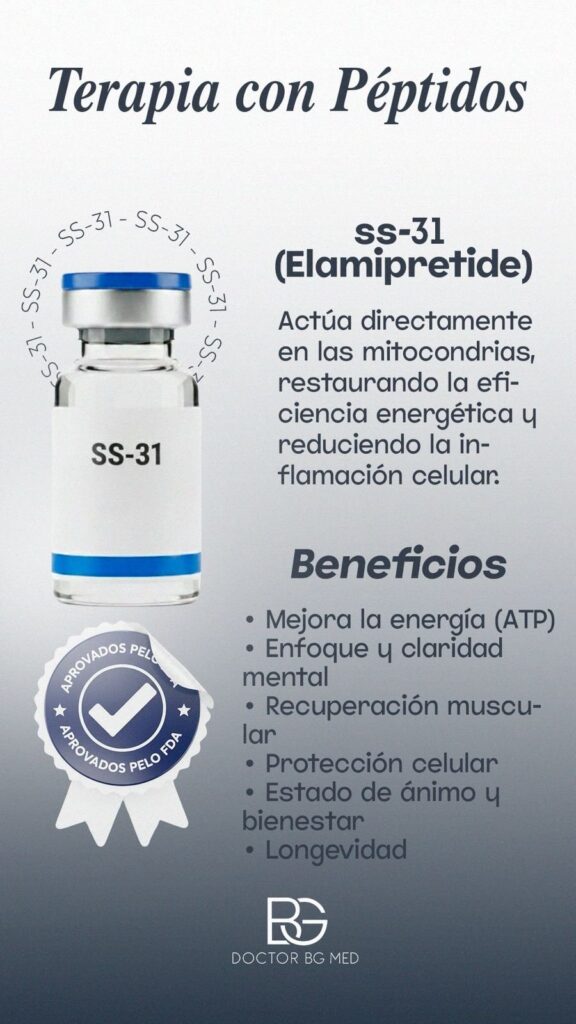
Elamipretide SS-31 peptide.
Mitochondrial peptide: energy, concentration and longevity.
How it works:
It acts directly on the mitochondria, restoring energy efficiency and reducing cellular inflammation.
For whom is it indicated:
Constant fatigue.
Low vitality.
Seniors over 35 years old.
Overworked professionals and sportspeople.
Quienes buscan longevidad.
What a improvement:
ATP energy.
Concentration and mental clarity.
Muscle recovery.
Cellular protection.
Mood and well-being.
Longevity.
SS-31 Mitochondrial energy and deep anti-aging.
Safe and effective if used under the supervision of a qualified doctor.
Approved by the FDA.
Doctor G Medical Excellence: Health, Bienestar and Longevidad
4243 W Hillsboro blvd Coconut Creek, 33073, FL
Phone: +1 (954) 638-1515
| Monday | 09:00 - 17:00 |
| Tuesday | 09:00 - 17:00 |
| Wednesday | 09:00 - 17:00 |
| Thursday | 09:00 - 17:00 |
| Friday | 09:00 - 17:00 |
| Saturday | 09:00 - 17:00 |
| Sunday | Closed |